

Very interesting my Armenian friend...
I find it very interesting-----> But thought it was a bit messy... Where exactly did Armenia/Hayastan cover in the year 2000BC?
After the Turks and som stupid Kurdish leaders genocided the Armenians - there ae few Armenians left in "West" Armenia... Let's say Turkey fell - Which areas would you claim as West armenia?
Thanks....

Facebook

Search

Welcome To Roj Bash Kurdistan

ASSYRIA
 Author: Rumtaya » Mon Jul 04, 2005 11:26 am
Hi my armenia brother yes i know we hv a long history together.
there are still assyrians and armenians marring eag other i know some cause our culture is near together.
i had onetime found amap of armenian empire but now i dont find it maybe armenia do you hv one
there are still assyrians and armenians marring eag other i know some
cause our culture is near together.
i had onetime found amap of armenian empire but now i dont find it maybe armenia do you hv one
-

Rumtaya - Ashna

- Posts: 803
- Joined: Sun Jul 03, 2005 2:33 pm
- Highscores: 0
- Arcade winning challenges: 0
- Has thanked: 0 time
- Been thanked: 0 time

Author: Rumtaya » Mon Jul 04, 2005 12:26 pm
hi diri i have a question can you post a map of an antic kurdistan ?
or do you have one of the media state and where the state starts not what they have hold after the years of 612 before christ.
thanks
and yes that was the map i was looking for lool
or do you have one of the media state and where the state starts not what they have hold after the years of 612 before christ.
thanks
and yes that was the map i was looking for lool
-
Rumtaya - Ashna
- Posts: 803
- Joined: Sun Jul 03, 2005 2:33 pm
- Highscores: 0
- Arcade winning challenges: 0
- Has thanked: 0 time
- Been thanked: 0 time
Author: Diri » Mon Jul 04, 2005 1:23 pm
Rumtaya - on that map you see the Median Empire just east of Armenian Empire and Assyrian Empire... It reads " M E D "... Do you see it?
And also - there is no "ancient" map of "Kurdistan" ---- > The Kurdish question is a very complicated one - I can't explain it with three words or just say - "Medya is Kurdistan... " - because as the map below will show you - Medya only partly is parallel to todays "Kurdistan"
Kurdistan as a term was (As I know of) not used before Ehmedê Xanî used it in the Kurdish epic love story "MEM Û ZÎN" - a Romeo and Juliet type of story in Kurdish... Here he mentions several times the name Kurdistan... And this was as I know of in the late 1200... But the name Kurdistan was naturally know before this - why should he call it Kurdistan if people hadn't heard it before...
KURD - STAN - Kurd is "Kurd" and Stan means "Land" - the comment about "stolen/steal" in another comment is just another translation of the word - We call Armenia "Ermenîstan" for example...
Kurdistan is the area of the Kurdish people... But the term "Kurd" can at most be from after the fall of the Median Empire:
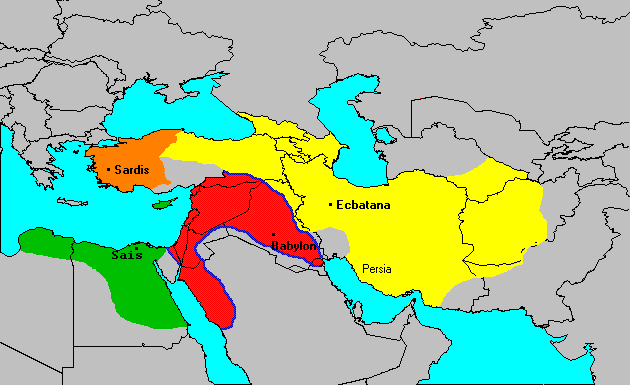
Medya is just ONE of the many cultures Kurds are the result of:
Halaf Culture - ca 9-8000 BC
Ubaid Culture - ca 5300 BC
Hurrian Culture - ca 4300 BC
Hittites and Mittani (Arian) Cultures - ca 2000 BC
THESE WERE ALL VERY DIFFERENT CULTURES AND PEOPLES... Within these there were other "sub" cultures - such as the MEDIAN and the ELAMÎ...
The Term Kurdistan may be a new thing - but the term "KURD" is VERY old:
I HOPE YOU FIND TIME TO READ ALL ON THIS SITE:(It is written by historians)
http://www.xs4all.nl/~tank/kurdish/htdocs/his/orig.html
Back to the map:
There are probably old Kurdistan maps - But I don't have knowledge of these... The Kurdistan term is based on where Kurds live... So lands which are majority Kurdish today are called Kurdistan - but Kurdistan is also a historical term - in the historical term Kurdistan is: Upper part of Mesopotami, Central and Eastern Part of Taurus Mountains - the Zagros Mountains, The Pontus Mountains... Anatolia and Iranian Plateu as they are called collectively... The maps I have showed here before are "historical" maps - and then there are maps based on population...
Here is an example of a Historical map: This map was given to UN in 1945 by a Kurdish Political Entity called Xoybûn:
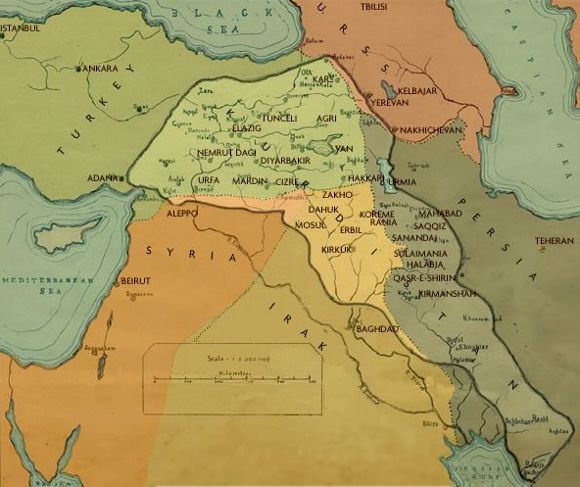
And this map: (This site is a good site about Kurdistan:
http://www.mtholyoke.edu/~awakata/Kurdistan.html )

And these are examples of "Where Kurds make up the majority of the population":
"LARGE KURDISTAN": (THIS IS THE KURDISTAN WE STRUGGLE TO MAKE INDEPENDENT:)
Kurds in 1919:

"SMALL KURDISTAN":
Kurds in todays context - The Middle East:

Kurds in: Iran/Turkey/Iraq & Syria

The peoples of Middles East:
Anatolia, Taurus mountains, Pontus, Zagros mountains, Mesopotamia Caucasus, Iranian Plateu - These have all been places where there existed NO BORDERS... Kurds/Assyrians/Armenians/Greek/Persian/Jews/Muslim/Christian etc etc etc - have all lived here for thousands of years - nobody said !this is Kurdistan - this is Armenia - this is Assyria"--- Yes there have been empires - a FEW men who have governd places... But not for or against people... They have done it for their own power...
All our nations have been VERY close and lived together without making much distinction between the nations as a whole... We have always know Assyrians and Armenians as our brothers...
THIS IS THE UN'S OFFICIAL SITE FOR NATIONS OF THE WORLD - AND HERE THERE IS A OFFICIAL CLEARIFICATION OF WHAT KURDISTANI IS:
http://www.unpo.org/member.php?arg=34
I hope you take time to read through some of the sites
And also - there is no "ancient" map of "Kurdistan" ---- > The Kurdish question is a very complicated one - I can't explain it with three words or just say - "Medya is Kurdistan... " - because as the map below will show you - Medya only partly is parallel to todays "Kurdistan"
Kurdistan as a term was (As I know of) not used before Ehmedê Xanî used it in the Kurdish epic love story "MEM Û ZÎN" - a Romeo and Juliet type of story in Kurdish... Here he mentions several times the name Kurdistan... And this was as I know of in the late 1200... But the name Kurdistan was naturally know before this - why should he call it Kurdistan if people hadn't heard it before...
KURD - STAN - Kurd is "Kurd" and Stan means "Land" - the comment about "stolen/steal" in another comment is just another translation of the word - We call Armenia "Ermenîstan" for example...
Kurdistan is the area of the Kurdish people... But the term "Kurd" can at most be from after the fall of the Median Empire:
Medya is just ONE of the many cultures Kurds are the result of:
Halaf Culture - ca 9-8000 BC
Ubaid Culture - ca 5300 BC
Hurrian Culture - ca 4300 BC
Hittites and Mittani (Arian) Cultures - ca 2000 BC
THESE WERE ALL VERY DIFFERENT CULTURES AND PEOPLES... Within these there were other "sub" cultures - such as the MEDIAN and the ELAMÎ...
The Term Kurdistan may be a new thing - but the term "KURD" is VERY old:
While many hypotheses have been advanced to connect the ethnic name 'Kurd' to that of the ancient Hurrian Qutils (Hallo, 1971) or the Khardukhoi (Carduchoi) of the Greek historian Xenophon (Cawkell, 1979), none have much merit. Whatever the roots, there is evidence to push the origin of the word 'Kurd' back at least to the early4th millennium BC, if not earlier. Even though I have not personally seen the term used by the old Mesopotamian sources, I was assured by my colleague Piotr Steinkeller, professor of Akkadian and Sumerian languages at Harvard University, of the accuracy of reports of such usage dating back 3800 years. The Akkadian term 'Kurtei' denoted an indeterminate portion or groups of inhabitants of the Zagros (and eastern Taurus) mountains. On the other hand, to their end in the 6th century BC, the Babylonians loosely (and apparently pejoratively) referred to almost everyone who lived in the Zagros-Taurus system a "Qutil," including the Medes! But Babylonian records also attest to many more specific subdivisional names such as the Mardi, Lullubi, Kardaka and Qardu, the last two of which have all been used frequently in the needless controversy over the roots and antiquity of the ethnic term 'Kurd' and the question of the presence of a general ethnic designator.
I HOPE YOU FIND TIME TO READ ALL ON THIS SITE:(It is written by historians)
http://www.xs4all.nl/~tank/kurdish/htdocs/his/orig.html
Back to the map:
There are probably old Kurdistan maps - But I don't have knowledge of these... The Kurdistan term is based on where Kurds live... So lands which are majority Kurdish today are called Kurdistan - but Kurdistan is also a historical term - in the historical term Kurdistan is: Upper part of Mesopotami, Central and Eastern Part of Taurus Mountains - the Zagros Mountains, The Pontus Mountains... Anatolia and Iranian Plateu as they are called collectively... The maps I have showed here before are "historical" maps - and then there are maps based on population...
Here is an example of a Historical map: This map was given to UN in 1945 by a Kurdish Political Entity called Xoybûn:
And this map: (This site is a good site about Kurdistan:
http://www.mtholyoke.edu/~awakata/Kurdistan.html )
And these are examples of "Where Kurds make up the majority of the population":
"LARGE KURDISTAN": (THIS IS THE KURDISTAN WE STRUGGLE TO MAKE INDEPENDENT:)
Kurds in 1919:
"SMALL KURDISTAN":
Kurds in todays context - The Middle East:
Kurds in: Iran/Turkey/Iraq & Syria
The peoples of Middles East:
Anatolia, Taurus mountains, Pontus, Zagros mountains, Mesopotamia Caucasus, Iranian Plateu - These have all been places where there existed NO BORDERS... Kurds/Assyrians/Armenians/Greek/Persian/Jews/Muslim/Christian etc etc etc - have all lived here for thousands of years - nobody said !this is Kurdistan - this is Armenia - this is Assyria"--- Yes there have been empires - a FEW men who have governd places... But not for or against people... They have done it for their own power...
All our nations have been VERY close and lived together without making much distinction between the nations as a whole... We have always know Assyrians and Armenians as our brothers...
THIS IS THE UN'S OFFICIAL SITE FOR NATIONS OF THE WORLD - AND HERE THERE IS A OFFICIAL CLEARIFICATION OF WHAT KURDISTANI IS:
http://www.unpo.org/member.php?arg=34
I hope you take time to read through some of the sites


-

Diri - Shaswar

- Posts: 6517
- Joined: Thu May 12, 2005 11:59 am
- Location: Norway
- Highscores: 0
- Arcade winning challenges: 0
- Has thanked: 2 times
- Been thanked: 10 times
- Nationality: Kurd
Author: Rumtaya » Mon Jul 04, 2005 5:08 pm
Thanks for the maps
But there is one problem i have with an kurdish state there is too much what you kurdish people want as kurdistan dont get me now wrong or so you know i want every nation get a state.
But you guys have to thing is this makeable or isnt it not should we look at one place and work for there for an Kurdistan.
My biggest point i think you didnt answerd where is the first ethnic beginn of kurds?
Like if i say we assyrians our first ethnic place is in the northen mesopotamia in the nineveh plains this always have been on majority Assyrian land you know what i mean? I hope yes
One thing what is very sad if there wouldnt be killded so many assyrians and armeans i think the middle east map would look very diffrent.
But you Kurdish people i see every good human as a friend and who fight for the right and ture site
I want you also to get a State because like we said there are too much arabic one
And what i think that this all became arabic cause arabs are stupid people the european did let kill us cause we have been to smar and we wouldnt give our oil so fast and for free or cheap all this fuckin oil has made so many people sad its the black death i like to say.
And that is also something kurdisch people should try to think about it is very very very hard to get Kirkuk because like you know there is a lot of oil like 70% of iraqs oil is in the northen mesopotamia mostly in middle and east where the kurdish people are the majority like you know and all others
And the last link i have read about it before. the other story ill try to take time and read it cause its a long story but i think a very good one which give me more information about kurdish.
TO our friendship my people yours and my armenian brothers have always lived good together just the turkish people did make this hate and fight between uns and that is still so they try to make us fight against eachother cause they know if we get one hand they will loose all what they have build well lets say all what they have stolen cause if we see it in the true way turkey is part of greece, kurdistan, armeania and assyria
What i wanted to say the turkish majority live in turkey can you tell me please if you know how much the kurdish popultion have been before 80 years????
cause i know kurdish have married before more wifes and had alot of children god make them not less i hope.
But there is one problem i have with an kurdish state there is too much what you kurdish people want as kurdistan dont get me now wrong or so you know i want every nation get a state.
But you guys have to thing is this makeable or isnt it not should we look at one place and work for there for an Kurdistan.
My biggest point i think you didnt answerd where is the first ethnic beginn of kurds?
Like if i say we assyrians our first ethnic place is in the northen mesopotamia in the nineveh plains this always have been on majority Assyrian land you know what i mean? I hope yes
One thing what is very sad if there wouldnt be killded so many assyrians and armeans i think the middle east map would look very diffrent.
But you Kurdish people i see every good human as a friend and who fight for the right and ture site
I want you also to get a State because like we said there are too much arabic one
And what i think that this all became arabic cause arabs are stupid people the european did let kill us cause we have been to smar and we wouldnt give our oil so fast and for free or cheap all this fuckin oil has made so many people sad its the black death i like to say.
And that is also something kurdisch people should try to think about it is very very very hard to get Kirkuk because like you know there is a lot of oil like 70% of iraqs oil is in the northen mesopotamia mostly in middle and east where the kurdish people are the majority like you know and all others
And the last link i have read about it before. the other story ill try to take time and read it cause its a long story but i think a very good one which give me more information about kurdish.
TO our friendship my people yours and my armenian brothers have always lived good together just the turkish people did make this hate and fight between uns and that is still so they try to make us fight against eachother cause they know if we get one hand they will loose all what they have build well lets say all what they have stolen cause if we see it in the true way turkey is part of greece, kurdistan, armeania and assyria
What i wanted to say the turkish majority live in turkey can you tell me please if you know how much the kurdish popultion have been before 80 years????
cause i know kurdish have married before more wifes and had alot of children god make them not less i hope.
-
Rumtaya - Ashna
- Posts: 803
- Joined: Sun Jul 03, 2005 2:33 pm
- Highscores: 0
- Arcade winning challenges: 0
- Has thanked: 0 time
- Been thanked: 0 time
Author: Armenian » Mon Jul 04, 2005 6:33 pm
By the was I was reading about the Assyrian dishes. I was surprised how much our cultures have in common. Not just food. There are a lot of other things. It's a shame So much of our Armenian, Assyrian Kurdish people have to live outside their motherland that we lives for thousands of years. I think the only was to get to our dream is if we all unite against our common enemy and demand our true rights.
-

Armenian - Shermin

- Posts: 201
- Joined: Sun Jul 03, 2005 6:23 pm
- Highscores: 0
- Arcade winning challenges: 0
- Has thanked: 0 time
- Been thanked: 0 time
Author: Rumtaya » Mon Jul 04, 2005 7:13 pm
Yes i know that too i think the assyrians and armenians have the best friendshipt but how it is now i dont know.
but like i said i know some assyrians who married to armenian and i know armenian married to assyrians.
do you guys have dolma lool yes i think maybe you call it also so
tell me some food names armenian
but like i said i know some assyrians who married to armenian and i know armenian married to assyrians.
do you guys have dolma lool yes i think maybe you call it also so
tell me some food names armenian
-
Rumtaya - Ashna
- Posts: 803
- Joined: Sun Jul 03, 2005 2:33 pm
- Highscores: 0
- Arcade winning challenges: 0
- Has thanked: 0 time
- Been thanked: 0 time
Author: Diri » Mon Jul 04, 2005 7:47 pm
My biggest point i think you didnt answerd where is the first ethnic beginn of Kurds?
To know where Kurds are from you have to look at where their cultures are from:
HALAF CULTURE: 9-8000 years BC

l. The earliest evidence thus far of a unified and distinct culture shared by the people inhabiting the Kurdish mountains relates to the period of the 'Halaf Culture' which emerged about 8000) years ago. Named for the ancient mound of Tel Halaf in what is uow Syrian Kurdistan (west of the town of Qamishli), this culture is best known for its easily recognizable style of pottery which, fortunately, was produced in abundance. Exquisitely painted, delicately designed Halaf pottery is easily distinguishable from earlier and later productions.
UBAID CULTURE: 5300 years BC
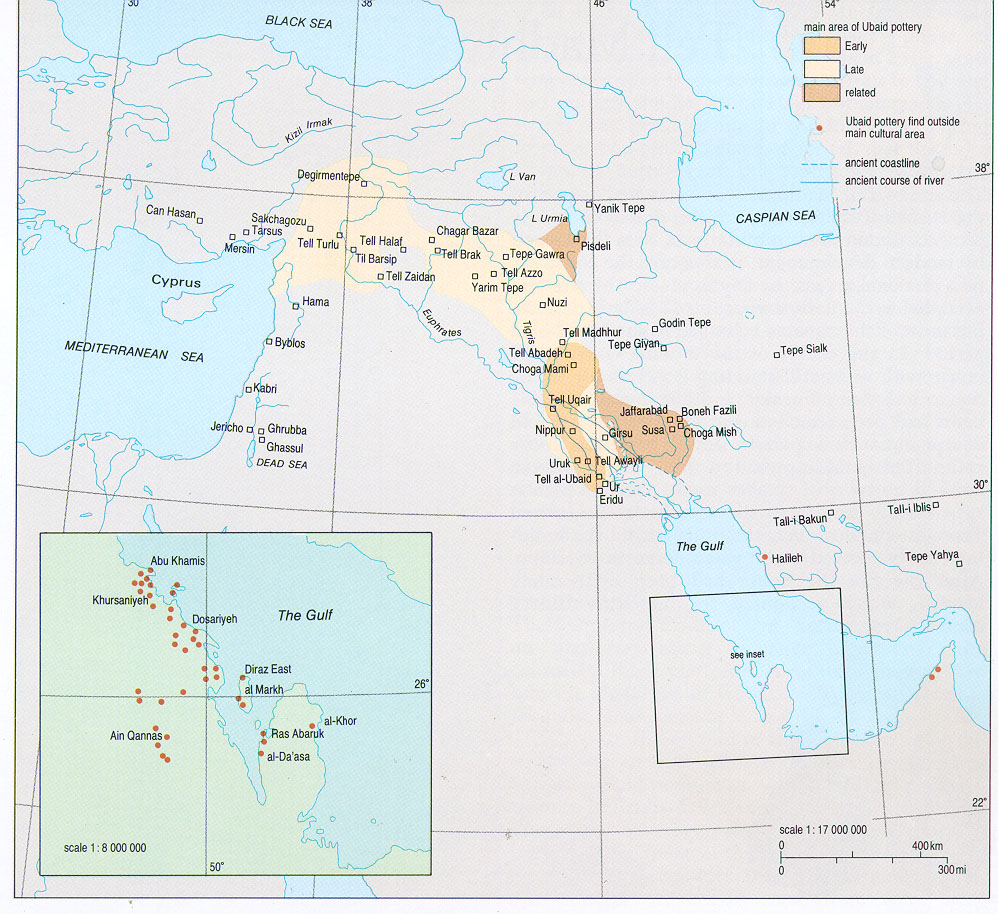
Of the language or ethnic affliation of the Ubaidians we know nothing beyond conjecture. However, it is they who gave the names Tigris and Euphrates to the rivers of Kurdistan and Mesopotamia, as well as the names of almost all of the cities we now recognize as Sumerian. The cultural impact of the Ubaidians on the mountain communities could have been vast, though apparently it was not particularly deep.
HURRIAN CULTURE & HITTITS & MITTANI BC 4300-2000 years BC

3. By approximately 4300 BC, a new culture, and possibly a new people, came to dominate the mountains: the Hurrians. Of the Hurrians we know much more, and the volume of our knowledge becomes greaterwith time. We know, for example, that the Hurrians spread far and wide into the Zagros-Taurus mountain systems and intruded for a time on the neighboring plains of Mesopotamia and the Iranian Plateau. However, they never expanded far from the mountains. Their economy was surprisingly integrated and focused, alongwith their political bonds, which ran generally parallel to the Zagros-Taurus mountains rather than radiating out to the lowlands, as was the case during the preceding Ubaid cultural period. Mountainplain economic exchanges remained secondaryin importance, judging by the archaeological remains of goods and their origins.
The Hurrians spoke a language or languages of the northeastern group of the Caucasian family of languages, distantly related to modern Lezgian and, by extension, to Georgian and Laz. The direction of their expansion is not yet understood and by no means should be taken as having been north-south, in other words, as an expansion out of the Caucuses. (It may well be that it was the Hurrians who introduced Caucasian languages into the Caucasus.)
For a long time the states founded by the Hurrians remained small, until around 2500 BC when larger political-military entities evolved out of the older city-states. Four polities are of special note: Urartu, Mushku, Subaru and Guti/Qutil. The kingdom of Mushku is nowbelieved to have brought about the final downfall of the Hittites in Anatolia. Their name survives in the city of Mush/Mus in north central Kurdistan of Turkey. The Subaru, who operated from the areas north of modern Arbil in central Kurdistan, have left their name in the populous and historic Kurdish tribal confederacy of Zubari, who still inhabit the areas north of Arbil. The name of Mount Ararat is a legacy of the Urartu. The Qutils of central and southern Kurdistan, after graduallyunifying the smaller mountain principalities, became strong enough in 2250 BC to actually annex Sumeria and the rest of lowland Mesopotamia. A Qutil dynasty ruled Sumeria for 130 years until 2120 BC.
Two legendary emporia, Melidi and Aratta, served the Hurrians in their inter-regional trade with the economies outside the mountains. With much certainty, Melidi is to be identified with modern Malatya, while Aratta is probably to be identified with the rich Qutil archaeological site of Godin Teppa near Kangawar in southern Kurdistan. By the middle of the 2nd millennium BC, the culture and people of Kurdistan appear to have been unified under a Hur- rian identity. The fundamental legacy of the Hurrians to the present culture of the Kurds is manifest in the realm of religion, mythology, martial arts, and even genetics. Nearly two-thirds of Kurdish tribal, topological and urban names are also likely of Hurrian origin: Buhtan, Talaban, Jelali, Barzan; Mardin, Ziwiya and Dinawar, to name a few. Mythological and religious symbols present in the art of the later Hurrian dynastics such as the Mannaeans of eastern Kurdistan, and the Lullus of the south, present in part what can still be observed in the Kurdish ancient religion of Yazdanism, better known today by its various denominations, such as Alevism, Yezidism, and Yar- sanism (Ahl-i Haqq).
It is fascinatingto recognize the origin of manytattooingmotifs still used by traditional Kurds to decorate their bodies as replicas of those which appear on Hurrian figurines. One such is the combination that incorporates serpent, sun disc, dog and comb motifs. In fact some of these Hurrian tattoo motifs are also present in the religious decorative arts of the Yezidi Kurds.
&

4. The portrait of a culturally homogenized Kurdistan was not to last. As early as 2000 BC, the vanguards of the Indo- European speaking tribal immigrants, such as the Hittites and Mittanis, had arrived in southwestern Asia. While the Hittites only marginally affected the mountain communities in Kurdis- tan, the Mittanis settled in Kurdistan and influenced the na- tives in several fields worthy of note, in particular the introduction of knotted rug weaving. Even rug designs intro- duced by the Mittanis and recognizable in Assyrian floor carv- ings remain the hallmark of Kurdish rugs and kelims. The modern mina-khani and chwar-such styles are basically the same as those the Assyrians depicted nearly 3000 years ago.
The Mittanis seem to have been an Indic, and not an Iranic group of people. Their pantheon, which includes names like Indra, Varuna, Suriya, Nasatya, is typically Indic. The Mittanis could have introduced during this early period some of the Indic tradition that appears to be manifest in the Kurdish religion of Yazdanism.
And lastly the Arians came: They were from South East Asia - India...The avalanche of Indo-European tribes, however, was to come about 1200 BC, raining havoc on the economy and settled culture in the mountains and lowlands alike. The north was settled by the Haiks, known to us as the Armenians, while the rest of the mountainsbecame targets of settlement for various Iranic peoples, such as the Medes, Persians, Scythians, Sar- mathians and Sagarthians (whose name survives in the name of the Zagros mountains).
By 850 BC, the last Hurrian states had been extinguished by the invading Aryans, whose sheer numbers of immigrants must have been considerable. They succeeded over time in chang- ing the Hurrian language(s) of the people in Kurdistan, as well as their genetic make-up. By the 3rd centuryBC, the Aryaniza- tion of the mountains was virtually complete.
When the ethnic Medes and Persians arrived on the eastern flanks of the Zagros around 1000 BC, a massive internal migra- tion from the northern and central Zagros toward the southern Zagros was in progress. By the 6th century BC, many large tribes which we now find among the Kurds were also present in the southern Zagros, in Fars and even Kirman. As early as the 3rd century BC, the 'Cyrtii' ('Kurti') are reportedby Greek, and later by Roman authors, to inhabit as much the southern (Persia or Pars/Fars) as the central and northern Zagros (Kur- distan proper). This was to continue for another millenium, when early Islamic sources also enumerate tens of Kurdish tribes in the southern Zagros. In time they were assimilated into the local populations. In fact, this has been a source of puzzlement for many modern writers who now find very few if any Kurds in the southern Zagros. Unaware of the history and extent of Kurdish historical migrations, they often draw the wrong conclusion: that the term 'Kurd' was not an ethnic name, but a designator of all nomads. This facile hypothesis is hardly worthy of refutation since no proof beyond a single, vague phrasc by a medieval writer, Hamza Isfahani, has never been produced to support it.
It is surprising to most that among the Kurds the Aryan cultural legacywas, and still remains secondary to that of the Hurrians. Culturally, Aryan nomads brought very little to add to what they found already present in the Zagros-Taurus region . As has always been the case, cultural sophistication and civilization are almost never associated with a nomadic way of life. In fact, nomads are traditionally thought to be destroyers of sedentary cultures, potential mortal adversaries in the struggle for pos- session of land and political dominance.
These Cultures are only the "big" cultures - there are MANY small cultures that were in and around Anatolia, Zagros and Taurus... So we have always been a part of these lands - just like Assyrians and Armenians we have lived in these areas for many thousand years...
Have a look at the "BIBLICAL MAP" Which was done by Romans - There you see it says "M E D" - That is "MEDYA" and it was the LAST Kurdish state - the Last Assyrian state was in Msopotamia and Northern Iraq---- > Medya and Babylon attacked Assyria - So Assyria was devided between Babylon and Medya in 612 BC... So since Kurds have permanently lived in Northern Iraq...
Medya (Sasanian Kings) fell when the Arabs came - in 7-8th century!One thing what is very sad if there wouldnt be killded so many assyrians and armeans i think the middle east map would look very diffrent.
Yes - Indeed!!! Then parts of Iraq and Syria would be ASSYRIA, Parts of Turkey and Azerbaijan would have been ARMENIA... But you know even if 5 million Assyrians have been genocided - Kurds were the majority population in all of South East Turkey... And they are still today...
My brother - many Kurds have been killed - by the MILLIONS! So if Kurds had been united in 1919 then Parts of Iran, Turkey, Iraq and Syria would be KURDISTAN...
You know - Everybody accepts that Armenians have been Genocided - that is good! But we must work to let people know about the Assyrian , Greek and Kurdish Genocides too... Millions of Greek, Assyrian and Kurds have been killed by the Turks... Also - Kurds have been killed by Iran, Syria and Iraq in large numbers...
That is why we must stand together... We have the same enemyWhat i wanted to say the turkish majority live in turkey can you tell me please if you know how much the Kurdish popultion have been before 80 years????
I realy don't know the exact number of people that lived then - but HALF of the Turkeys population was Kurdish - now millions have been assimilated, killed and forcefully moved! Today There are AT LEAST 18 million Kurds in Turkey - Istanbul has ca 4 million Kurds! Kurds are the majority of the population in 24 Turkish Provinces, in 7 Iranian Provinces, in 4 in Iraq with 30-40 % in Diyala and Ninawa provinces... There are 40 million Kurds in the world!But you guys have to thing is this makeable or isnt it not should we look at one place and work for there for an Kurdistan.
- Yes - We are asking for VERY MUCH!
TO our friendship my people yours and my armenian brothers have always lived good together just the turkish people did make this hate and fight between uns and that is still so they try to make us fight against eachother cause they know if we get one hand they will loose all what they have build well lets say all what they have stolen cause if we see it in the true way turkey is part of greece, kurdistan, armeania and assyria
Yes - We have one common enemy... We have had a long lasting friendship and brotherhood... There have been many intermarriges between us before... But now as you say - our enemies want to make war between us! Turkey will FALL! And then we will all share and divide the land between us!
You know - Turkey is the real thief - they have stolen our culture, dances, songs, clothes and culture and they dare to say that it IS TURKISH! cause i know kurdish have married before more wifes and had alot of children god make them not less i hope.
HeheheAnd what i think that this all became arabic cause arabs are stupid people the european did let kill us cause we have been to smar and we wouldnt give our oil so fast and for free or cheap all this fuckin oil has made so many people sad its the black death i like to say.
You know - We Kurds support every nation that wants to have a state - ASSYRIA will be supported by Kurdistan - we WANT other states there because - yes there are TOO many Arab states - and they are our enemies too - Also it would be wrong to only want state for Kurds and not for Assyrians - because we are brothers and we can support eachother!
And oil is the problem mostly... Kirkuk is a Kurdish city - Babagurgur - we called it before - "TEMPLE OF FIRE" Because Kurds were Yezidi before and we called it Temple of Fire because in Yezidi religion Fire and Sun are holy!

We have a right to get Kirkuk... just like Assyrians have a right to Nineveh City... Because ALL your culture is around Ninawa Plains... So I fully agree - you must get that part and other parts of Iraq and Syria!
I will look for a map that devides the Middle East in Assyria/Armenia/Greece and Kurdistan...
You know my brother it is hard to say "Everybody should have the oland they have their origins from"... Because our last Kingdom was around Urmiye and all the way to Tehran - Todays Azerbaijan was MEDYA...
You know if Kurds are gonna go back then the Turks must go back to MONGOLIA!
Brotherhood lasts much longer than anything...-
Diri - Shaswar
- Posts: 6517
- Joined: Thu May 12, 2005 11:59 am
- Location: Norway
- Highscores: 0
- Arcade winning challenges: 0
- Has thanked: 2 times
- Been thanked: 10 times
- Nationality: Kurd
Author: Armenian » Tue Jul 05, 2005 3:24 am
Rumtaya wrote:Yes i know that too i think the assyrians and armenians have the best friendshipt but how it is now i dont know.
but like i said i know some assyrians who married to armenian and i know armenian married to assyrians.
do you guys have dolma lool yes i think maybe you call it also so
tell me some food names armenian
Yes of course we have dolma. We have harisa, but we make it with chicken and I think you make harisa with pork if I am not mistaken. We have tabuleh. I forgot otrher dishes that we have in common. I'll look into it.
-
Armenian - Shermin
- Posts: 201
- Joined: Sun Jul 03, 2005 6:23 pm
- Highscores: 0
- Arcade winning challenges: 0
- Has thanked: 0 time
- Been thanked: 0 time
Author: Armenian » Tue Jul 05, 2005 6:24 am
I found this in an Assyrian website and it is amazing how both Armenian and Assyrian Genocides were planned the same way.
The Assyrian Genocide During World War I.
The twentieth century has, however, been the darkest chapter of Assyrian history. When Turkey entered first World War in November 1914, Assyrians were told that the liberation of the Ottoman Empire was near. It was a time of promises for an independent statehood. The Assyrians, by request sided with the Allies, first with the Russians then with the British forces. The hope for freedom and a national home promised to them on the sacred soil of their ancestors was instead met with the genocide of their people perpetrated by the Ottoman Turks, causing the massacre of more than 750,000 indigenous Assyrians (two thirds of their total population in Turkey) and loss of 750 of their villages, as well as the slaughter of 1.5 million Armenians and over 1 million Hellenes . The Assyrian Genocide was a part of the same drawn-out, systematic official policy implemented under the cover of war on the Armenians and the Hellenes and remains today an untold Holocaust. As we all know, the Young Turk nationalists planned to create a Pan-Turkish state or “Turan” stretching from the Bosphorus to the frontier of China, and these three indigenous Christian nations were a hurdle they had to overcome at all costs. Actually, Dr. Behaeddin Shakir (one of the Young Turks’ chief ideologues) told the assembly at the 1911 Congress of the CUP in Salonika that, “the nations that remain from the old times in our empire are akin to foreign and harmful weeds that must be uprooted. To clear our land…” The description used here being identical to that used by the Nazi’s to describe the Jews just before the Holocaust.
In August 1914, the Turks began this policy by violently persecuting the Assyrians residing in the areas around Hakkiari, Mardin and Midyat.
The Turkish government began by singling out the able-bodied Assyrian men as the most likely to resist. This was easy enough as most of them had already been drafted into the army. Military commanders were told to separate them from other soldiers. Some were transferred into labour battalions, where they were worked to death or killed by hunger, exposure or disease for which the authorities would provide no relief. Others were simply taken to a secluded spot and murdered. Some Assyrian soldiers, bound together and defenceless, were forced to march along isolated roads where they were subject to pre-arranged attacks by Kurdish tribesmen. Many thousands of soldiers were killed in this manner.
The government then turned to Assyrians in the civilian population. First, to make their victims defenceless, the government denied the Assyrian citizens the right to keep and bear arms. Soldiers and police were assigned the task of confiscating weapons. Homes were ransacked, and many Assyrians suspected of having weapons were tortured. In fear, some acquired weapons, just so that they could have something to turn in to the authorities and thus avoid torture.
Secondly, the Turkish government rounded up the leaders and the educated of the Assyrian communities in the larger cities - those most likely to speak out and be heard. These people were deported to places where they died in a similar way to the soldiers.
With most of the Assyrian men out of the way, the populace stripped of their weapons, and their leaders exiled or dead, the Assyrians in the Ottoman Empire were defenceless. The government then moved in for the kill. Moving from village to village, police and soldiers gathered together the Assyrian males, marched them out to some secluded spot, and slaughtered them.
A few days later the remaining Assyrians in the villages – women, children and some elderly – would be gathered together and led on a forced deportation. These became death marches. Again, the Assyrians were subject to prearranged attacks. Prisoners were released from Turkish jails for the sole purpose of attacking convoys of Assyrian deportees. Muslim villagers and Kurdish tribes attacked the convoys, raping, killing and looting them. Other convoys were simply massacred by soldiers. Those not killed in the deportations were led to concentration camps in the Mesopotamian desert, where countless more died. This process is confirmed by the many eyewitness accounts left to us, in particular those in Shall This Nation Die? by Fr. Joseph Naayem.
In 1915, according to Mor Ignatius Severius Afrem Barsaum, late Patriarch of the Syriac Orthodox Church, a documented 156 Syriac Orthodox churches and monasteries were destroyed throughout the Assyrian homeland. This figure does not include those belonging to the Church of the East and Syriac and Chaldean Catholic Assyrians. In December 1916, the New York Times reported that Mor Ignatius Abdullah II, the Syriac Orthodox Patriarch at that time, had been “Murdered in His Residence by a Band of Turks.”
Being at this time at war with Russia, the Turks did not limit themselves to killing their own Assyrian citizens. In the beginning of January 1915 and in mid-1918, Ottoman troops entered the region on the western shore of Lake Urmia, part of the Persian Empire, where they massacred all up nearly 100,000 Assyrians and tens of thousands of Armenians. The 1915 massacres are described in detail in the Blue Book (Treatment of the Armenians in the Ottoman Empire), where a chapter containing these documents is dedicated to the Assyrians. This was later published as a separate booklet, Treatment of the Assyrians in the Ottoman Empire, though when the original book was translated into French, the chapter on the Assyrians was left out.
Apart from those who managed to survive the death marches and massacres, there were others. Through the efforts of their Patriarch Mar Joseph Emmanuel II Thomas and the aid of the Vatican and French Government, the greater part of the Chaldean Assyrians residing in the Mosul vilayet escaped the killings. Official pardons were also issued to different Assyrian communities in Kharput, Mardin and Diyarbakir, though this was only after the majority of them had been decimated.
There were also two centres of resistance: Tur-‘Abdin and Hakkiari (later Urmia) where Assyrians banded together to defend themselves against the attacks from the Turks and their Kurdish and Persian allies. The greatest leaders in the last two areas were General Agha Petros who corresponded with Andranik Pasha and Mar Benyamin Shimun, Catholicos-Patriarch of the Church of the East, who was assassinated by a Kurdish chieftain in March 1918.
After the Ottoman Empire was dissolved many Assyrians remained within the Turkish border. From 1919 a new wave of killing began as the popular nationalist regime under Kemal Ataturk, which shared the Young Turks’ desire for ethnic purity, came to power. Assyrian lands that had become part of Syria and Iraq were again invaded, resulting in the massacre of many people. Within Turkey, ethnic cleansing cost the lives of thousands more Assyrians, many of whom left during the great purge of 1924.
After Ataturk’s westernisation and his attempt to turn the formerly multinational Ottoman state into a solely Turkish one, the rights of Assyrians were abolished and persecutions continue to this day. By 1922, the Assyrian population in Turkey had been reduced to less than 200,000 people. Now the number of Assyrians in Turkish Mesopotamia is barely 3,000 and the Turkish Government does not recognise Assyrians as an ethnic minority within its borders, preferring to call us “Turco-Semites” or “Semitic Turks”.
¨ Conclusion and Recognition
It is clear from all evidence presented that Assyrians did suffer in the same Genocide as did the Armenians, Hellenes and the Jewish. This recognition will help our Assyrian nation and its organisations in their attempt to strengthen our national existence in the homeland as well as in the diaspora and to attain our human rights to cultural expression and democratic political participation. This act of recognition will as a leading example of credibility enable us to initiate international awareness of the Assyrian nation's rights to existence and preservation. Only then can our nation succeed in finding its rightful place among the nations of the world and in creatively making its special contribution to the universal cultural and further development of mankind.
We wish that the oppressors may take a real lesson that will take care of the unremembered past victims but also today’s victims of that first, but nevertheless still ongoing genocide, ethnocide and its denial.
Thus we wish that this Assyrian untold holocaust may not be instrumentalised to blind-fold the world but that its remembrance be a blessing for the world by increasing the world community's awareness to fight the evils and demons of genocide in a brotherly spirit.
Trusting that you will appreciate the urgent character of this petition and convinced that the increase in mutual awareness and friendly co-operation will greatly help for a better future of our nation, we remain respectfully in anticipated wait of your favourable response.
Hermiz Shahen
Secretary,
Assyrian Universal Alliance-Australia Chapter
The Assyrian Genocide During World War I.
The twentieth century has, however, been the darkest chapter of Assyrian history. When Turkey entered first World War in November 1914, Assyrians were told that the liberation of the Ottoman Empire was near. It was a time of promises for an independent statehood. The Assyrians, by request sided with the Allies, first with the Russians then with the British forces. The hope for freedom and a national home promised to them on the sacred soil of their ancestors was instead met with the genocide of their people perpetrated by the Ottoman Turks, causing the massacre of more than 750,000 indigenous Assyrians (two thirds of their total population in Turkey) and loss of 750 of their villages, as well as the slaughter of 1.5 million Armenians and over 1 million Hellenes . The Assyrian Genocide was a part of the same drawn-out, systematic official policy implemented under the cover of war on the Armenians and the Hellenes and remains today an untold Holocaust. As we all know, the Young Turk nationalists planned to create a Pan-Turkish state or “Turan” stretching from the Bosphorus to the frontier of China, and these three indigenous Christian nations were a hurdle they had to overcome at all costs. Actually, Dr. Behaeddin Shakir (one of the Young Turks’ chief ideologues) told the assembly at the 1911 Congress of the CUP in Salonika that, “the nations that remain from the old times in our empire are akin to foreign and harmful weeds that must be uprooted. To clear our land…” The description used here being identical to that used by the Nazi’s to describe the Jews just before the Holocaust.
In August 1914, the Turks began this policy by violently persecuting the Assyrians residing in the areas around Hakkiari, Mardin and Midyat.
The Turkish government began by singling out the able-bodied Assyrian men as the most likely to resist. This was easy enough as most of them had already been drafted into the army. Military commanders were told to separate them from other soldiers. Some were transferred into labour battalions, where they were worked to death or killed by hunger, exposure or disease for which the authorities would provide no relief. Others were simply taken to a secluded spot and murdered. Some Assyrian soldiers, bound together and defenceless, were forced to march along isolated roads where they were subject to pre-arranged attacks by Kurdish tribesmen. Many thousands of soldiers were killed in this manner.
The government then turned to Assyrians in the civilian population. First, to make their victims defenceless, the government denied the Assyrian citizens the right to keep and bear arms. Soldiers and police were assigned the task of confiscating weapons. Homes were ransacked, and many Assyrians suspected of having weapons were tortured. In fear, some acquired weapons, just so that they could have something to turn in to the authorities and thus avoid torture.
Secondly, the Turkish government rounded up the leaders and the educated of the Assyrian communities in the larger cities - those most likely to speak out and be heard. These people were deported to places where they died in a similar way to the soldiers.
With most of the Assyrian men out of the way, the populace stripped of their weapons, and their leaders exiled or dead, the Assyrians in the Ottoman Empire were defenceless. The government then moved in for the kill. Moving from village to village, police and soldiers gathered together the Assyrian males, marched them out to some secluded spot, and slaughtered them.
A few days later the remaining Assyrians in the villages – women, children and some elderly – would be gathered together and led on a forced deportation. These became death marches. Again, the Assyrians were subject to prearranged attacks. Prisoners were released from Turkish jails for the sole purpose of attacking convoys of Assyrian deportees. Muslim villagers and Kurdish tribes attacked the convoys, raping, killing and looting them. Other convoys were simply massacred by soldiers. Those not killed in the deportations were led to concentration camps in the Mesopotamian desert, where countless more died. This process is confirmed by the many eyewitness accounts left to us, in particular those in Shall This Nation Die? by Fr. Joseph Naayem.
In 1915, according to Mor Ignatius Severius Afrem Barsaum, late Patriarch of the Syriac Orthodox Church, a documented 156 Syriac Orthodox churches and monasteries were destroyed throughout the Assyrian homeland. This figure does not include those belonging to the Church of the East and Syriac and Chaldean Catholic Assyrians. In December 1916, the New York Times reported that Mor Ignatius Abdullah II, the Syriac Orthodox Patriarch at that time, had been “Murdered in His Residence by a Band of Turks.”
Being at this time at war with Russia, the Turks did not limit themselves to killing their own Assyrian citizens. In the beginning of January 1915 and in mid-1918, Ottoman troops entered the region on the western shore of Lake Urmia, part of the Persian Empire, where they massacred all up nearly 100,000 Assyrians and tens of thousands of Armenians. The 1915 massacres are described in detail in the Blue Book (Treatment of the Armenians in the Ottoman Empire), where a chapter containing these documents is dedicated to the Assyrians. This was later published as a separate booklet, Treatment of the Assyrians in the Ottoman Empire, though when the original book was translated into French, the chapter on the Assyrians was left out.
Apart from those who managed to survive the death marches and massacres, there were others. Through the efforts of their Patriarch Mar Joseph Emmanuel II Thomas and the aid of the Vatican and French Government, the greater part of the Chaldean Assyrians residing in the Mosul vilayet escaped the killings. Official pardons were also issued to different Assyrian communities in Kharput, Mardin and Diyarbakir, though this was only after the majority of them had been decimated.
There were also two centres of resistance: Tur-‘Abdin and Hakkiari (later Urmia) where Assyrians banded together to defend themselves against the attacks from the Turks and their Kurdish and Persian allies. The greatest leaders in the last two areas were General Agha Petros who corresponded with Andranik Pasha and Mar Benyamin Shimun, Catholicos-Patriarch of the Church of the East, who was assassinated by a Kurdish chieftain in March 1918.
After the Ottoman Empire was dissolved many Assyrians remained within the Turkish border. From 1919 a new wave of killing began as the popular nationalist regime under Kemal Ataturk, which shared the Young Turks’ desire for ethnic purity, came to power. Assyrian lands that had become part of Syria and Iraq were again invaded, resulting in the massacre of many people. Within Turkey, ethnic cleansing cost the lives of thousands more Assyrians, many of whom left during the great purge of 1924.
After Ataturk’s westernisation and his attempt to turn the formerly multinational Ottoman state into a solely Turkish one, the rights of Assyrians were abolished and persecutions continue to this day. By 1922, the Assyrian population in Turkey had been reduced to less than 200,000 people. Now the number of Assyrians in Turkish Mesopotamia is barely 3,000 and the Turkish Government does not recognise Assyrians as an ethnic minority within its borders, preferring to call us “Turco-Semites” or “Semitic Turks”.
¨ Conclusion and Recognition
It is clear from all evidence presented that Assyrians did suffer in the same Genocide as did the Armenians, Hellenes and the Jewish. This recognition will help our Assyrian nation and its organisations in their attempt to strengthen our national existence in the homeland as well as in the diaspora and to attain our human rights to cultural expression and democratic political participation. This act of recognition will as a leading example of credibility enable us to initiate international awareness of the Assyrian nation's rights to existence and preservation. Only then can our nation succeed in finding its rightful place among the nations of the world and in creatively making its special contribution to the universal cultural and further development of mankind.
We wish that the oppressors may take a real lesson that will take care of the unremembered past victims but also today’s victims of that first, but nevertheless still ongoing genocide, ethnocide and its denial.
Thus we wish that this Assyrian untold holocaust may not be instrumentalised to blind-fold the world but that its remembrance be a blessing for the world by increasing the world community's awareness to fight the evils and demons of genocide in a brotherly spirit.
Trusting that you will appreciate the urgent character of this petition and convinced that the increase in mutual awareness and friendly co-operation will greatly help for a better future of our nation, we remain respectfully in anticipated wait of your favourable response.
Hermiz Shahen
Secretary,
Assyrian Universal Alliance-Australia Chapter
-
Armenian - Shermin
- Posts: 201
- Joined: Sun Jul 03, 2005 6:23 pm
- Highscores: 0
- Arcade winning challenges: 0
- Has thanked: 0 time
- Been thanked: 0 time
Author: Diri » Tue Jul 05, 2005 10:45 am
We have Dolme too And so do the Greek
Dolma is the Middle East national dish
Very interesting letter/article - I thought it was very accurate in it's descriptions - By the way - that man that was killed by the Kurdish Prince:
He was killed by Simko Agha- as we call him - and Ismael is his real name... He was the sole Prince in the area around Urmiye Lake... He was an evil man who killed thousands of Kurds - his own people... He was mad - He could for example just out of pure insanity throw a person who had done nothing wrong into the barn and let him stay there for a day or two - he was mentaly sick!
You know what happened?? The Armenian leader(if there was such a thing) or ONE of them came running to Persia and to Simko - He signed an agreemnet with Simko----> The agreement was that they were gonna fight against the Turks together... And Simko as I said was MAD - so he killed all 10 of the Armenians that had come to sign the agreement... H wasn't paid by Turks - Or Persia - He was just MAD - Turks and Persia were both enemies of Simko... But he blew the chance to win against both of them - if Kurds and Armenians had been united they would have won the "war"...
This article - it says nothing about all the Kurds that were killed in the Genocides... As he writes : Turkey didn't want other ethnicities in "Turan"... SO Kurds were also targeted in large numbers... And after Atatürk came to power it was much worse for Kurds - because now they were the main target of genocide...
Sad history... Assyrians and Armenians and Greek have suffered much... The first two were also killed by mercenarie Kurds - and the Kurd and Greek later fought the Turks together... Today if you go to Kurdish areas you will find that there are many Kurds with Greek, Armenian and Assyrian blood... Intermarriage was a part of the culture there before the Turks started to target the other ethinicties...
And so do the Greek
Dolma is the Middle East national dish
Very interesting letter/article - I thought it was very accurate in it's descriptions - By the way - that man that was killed by the Kurdish Prince:
.The greatest leaders in the last two areas were General Agha Petros who corresponded with Andranik Pasha and Mar Benyamin Shimun, Catholicos-Patriarch of the Church of the East, who was assassinated by a Kurdish chieftain in March 1918
He was killed by Simko Agha- as we call him - and Ismael is his real name... He was the sole Prince in the area around Urmiye Lake... He was an evil man who killed thousands of Kurds - his own people... He was mad - He could for example just out of pure insanity throw a person who had done nothing wrong into the barn and let him stay there for a day or two - he was mentaly sick!
You know what happened?? The Armenian leader(if there was such a thing) or ONE of them came running to Persia and to Simko - He signed an agreemnet with Simko----> The agreement was that they were gonna fight against the Turks together... And Simko as I said was MAD - so he killed all 10 of the Armenians that had come to sign the agreement... H wasn't paid by Turks - Or Persia - He was just MAD - Turks and Persia were both enemies of Simko... But he blew the chance to win against both of them - if Kurds and Armenians had been united they would have won the "war"...
This article - it says nothing about all the Kurds that were killed in the Genocides... As he writes : Turkey didn't want other ethnicities in "Turan"... SO Kurds were also targeted in large numbers... And after Atatürk came to power it was much worse for Kurds - because now they were the main target of genocide...
Sad history... Assyrians and Armenians and Greek have suffered much... The first two were also killed by mercenarie Kurds - and the Kurd and Greek later fought the Turks together... Today if you go to Kurdish areas you will find that there are many Kurds with Greek, Armenian and Assyrian blood... Intermarriage was a part of the culture there before the Turks started to target the other ethinicties...
-
Diri - Shaswar
- Posts: 6517
- Joined: Thu May 12, 2005 11:59 am
- Location: Norway
- Highscores: 0
- Arcade winning challenges: 0
- Has thanked: 2 times
- Been thanked: 10 times
- Nationality: Kurd
Author: Rumtaya » Tue Jul 05, 2005 2:29 pm
Thanks armenian for the post i have written alot about the genozid and it was planed from the beginn till the end.
@DIRI
who was killed by simko? the assyrian patriach
about that story i heard our patriach was going to talk to some kurdish fighter or so and as he wanted to go back from visit they shoot him infront of the door.
so then we assyrian lost a very special person who we needed to present us.
TO AGHA PATROS i have to say this MAN was more than a MAN he have been very smart and taff
he had 15 fights against turkey non one of them he lost so if the france didnt catched him he would finish the whole turkey army.
the problem is that there were some sorry if i said that stupid and foolish kurds who suppourtet the turkey site.
i have heard that in the genozid some kurdish people had given assyrians and armenians a place they can hide but like i say wanst enough people to hide.
DO YOU GUYS HEARD SOMETHING OF SIMELEH??????
simeleh is in the northeniraq after iraq had been founded there was one more genozid on assyrian and it was planed and done by the iraqi arabic army.
head DIRI go to this link you can see the assyrian population its down on the reast site but i think the numbers has
changedhttp://www.aina.org/aol/peter/brief.htm
@DIRI
who was killed by simko? the assyrian patriach
about that story i heard our patriach was going to talk to some kurdish fighter or so and as he wanted to go back from visit they shoot him infront of the door.
so then we assyrian lost a very special person who we needed to present us.
TO AGHA PATROS i have to say this MAN was more than a MAN he have been very smart and taff
he had 15 fights against turkey non one of them he lost so if the france didnt catched him he would finish the whole turkey army.
the problem is that there were some sorry if i said that stupid and foolish kurds who suppourtet the turkey site.
i have heard that in the genozid some kurdish people had given assyrians and armenians a place they can hide but like i say wanst enough people to hide.
DO YOU GUYS HEARD SOMETHING OF SIMELEH??????
simeleh is in the northeniraq after iraq had been founded there was one more genozid on assyrian and it was planed and done by the iraqi arabic army.
head DIRI go to this link you can see the assyrian population its down on the reast site but i think the numbers has
changedhttp://www.aina.org/aol/peter/brief.htm
-
Rumtaya - Ashna
- Posts: 803
- Joined: Sun Jul 03, 2005 2:33 pm
- Highscores: 0
- Arcade winning challenges: 0
- Has thanked: 0 time
- Been thanked: 0 time
Author: Diri » Tue Jul 05, 2005 3:01 pm
Rumtaya - That link didn't work - can you make a new link? Thanks...
No that is okey - you can say that - there are stupid and foolish Kurds, Assyrians, Armenians, Greek, Turks, Persian, Arabs etc etc etc - So it is okey
No nation is ever perfect...
I haven't hear that before - I have heard the one about the Armenian leader who was killed by Simko----> but there are many people who were betrayed----> Mostly they have been killed by Turkish army, but Turkish army had payed Kurdish lords for killing them...
But it is true - like I said - there are many Kurds that have Assyrian or Armenian blood - because from what I know most civielian Kurds helped Armenians and Assyrians when they were being killed... There are many stories about Kurds who gave food and hiding places to Assyrians and specially to Armenians...
There is an Armenian singer - Aram Tigran - he has learnet Kurdish and is a famous artist in Kurdistan... He has been on Kurdish TV hundreds of times... He and his family were saved by Kurds - that is why he sings in Kurdish and he is famous - he shows his grattitude to Kurds that helped them...
And there are many similar stories - when Kurds gave shelter to Armenians and Assyrians they often married them and often they adopted them as their sisters and brothers... So they became a part of their family...
But Kurds will always feel sorry for all the Armenians and Assyrians that were killed by Kurds...
He accept our cruelty and wish that we are forgiven... We do not want anyone to be oppressed - we too are oppressed and we too have been killed and genocided - we know how you feel... We feel eachother....
sorry if i said that stupid and foolish kurds
No that is okey - you can say that - there are stupid and foolish Kurds, Assyrians, Armenians, Greek, Turks, Persian, Arabs etc etc etc - So it is okey
No nation is ever perfect...
the assyrian patriach
about that story i heard our patriach was going to talk to some kurdish fighter or so and as he wanted to go back from visit they shoot him infront of the door.
I haven't hear that before - I have heard the one about the Armenian leader who was killed by Simko----> but there are many people who were betrayed----> Mostly they have been killed by Turkish army, but Turkish army had payed Kurdish lords for killing them...
But it is true - like I said - there are many Kurds that have Assyrian or Armenian blood - because from what I know most civielian Kurds helped Armenians and Assyrians when they were being killed... There are many stories about Kurds who gave food and hiding places to Assyrians and specially to Armenians...
There is an Armenian singer - Aram Tigran - he has learnet Kurdish and is a famous artist in Kurdistan... He has been on Kurdish TV hundreds of times... He and his family were saved by Kurds - that is why he sings in Kurdish and he is famous - he shows his grattitude to Kurds that helped them...
And there are many similar stories - when Kurds gave shelter to Armenians and Assyrians they often married them and often they adopted them as their sisters and brothers... So they became a part of their family...
But Kurds will always feel sorry for all the Armenians and Assyrians that were killed by Kurds...
He accept our cruelty and wish that we are forgiven... We do not want anyone to be oppressed - we too are oppressed and we too have been killed and genocided - we know how you feel... We feel eachother....
-
Diri - Shaswar
- Posts: 6517
- Joined: Thu May 12, 2005 11:59 am
- Location: Norway
- Highscores: 0
- Arcade winning challenges: 0
- Has thanked: 2 times
- Been thanked: 10 times
- Nationality: Kurd
Author: Armenian » Tue Jul 05, 2005 4:12 pm
Diri, I hope you understand that the purpose of posting that threat was not to say anything negative about Kurds. The puprose was to show similarities of both Armenian and Assyian genocides.
-
Armenian - Shermin
- Posts: 201
- Joined: Sun Jul 03, 2005 6:23 pm
- Highscores: 0
- Arcade winning challenges: 0
- Has thanked: 0 time
- Been thanked: 0 time
Who is online
Registered users: Bing [Bot], Google [Bot], Majestic-12 [Bot]