

It is easy to become both dejected and confused regarding the situation in Iraq. But there is a pattern behind the chaotic killing. Or several patterns, to be more correct. Islamists kill Shiites because they regard them as unfaithful. Shiites kill Sunnis in revenge for the wrongs of Saddam. Baathists kill to create chaos.
And then there are the Christians.
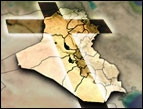
Islamists have the country's Christian minority as a target. A Christian family woke up one morning and discovered their sons head in front of the door. A Christian teenager was crucified in Basra in October. Two nuns, 85 and 79 years old, were murdered in Kirkuk in Mars. Priests are killed, churches are burned down, young Christian women are raped. The only reason: they are Christians. Everything is done in order create an Iraq that is Christenrein.
Before the liberation in 2003 about eight percent, less than 1.5 million of Iraq's population, was Christian. 95% of Christians are Assyrians in ethnicity (also called Chaldeans and Syriacs); a smaller group are Armenians. They are not Christians as a result of the Western missions of the 18th and 19th centuries; they trace their Christian roots to the first century. The Assyrians have a history that stretches further back in time, long before the Christian era. They alone have the right to consider themselves as Iraq's indigenous population.
Many Christians had emigrated by the 1990s, but the big upheaval came with the overthrow of Saddam. It is believed half of Iraq's Christians have fled the country since then. They constitute between one third and half of all Iraqi refugees. They are tired of seeing their churches being bombed and their friends killed. This is not only a terrible tragedy at a personal level -- an ancient culture is at risk of becoming extinct. Most refugees have settled down in the neighbouring countries of Jordan, Syria and Turkey. Sweden has shown the greatest hospitality in Europe: The Swedish town of Södertälje has accepted as many refugees as the entire USA.
The Assyrians living in the West (there are tens of thousands in Sweden alone) have done what they can in order to gain the attention of the world community to the ongoing catastrophe, which some are calling genocide. One of the strongest advocates is the award winning Assyrian journalist Nuri Kino from Sweden. He recently visited refugees in Jordan together with an Assyrian nun and wrote in his blog spot:
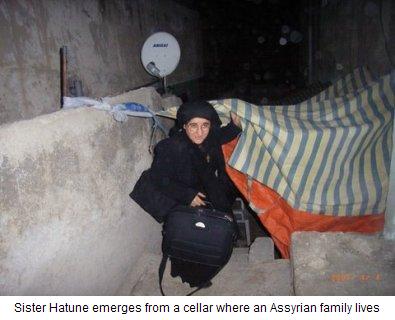
Sister Hatune, considered by some as the new Mother Teresa, has built more than one hundred homes for poor Indians. She is known to be an incredibly strong and enterprising person, something she also proved to be. The first two days. But today she could not cope with it anymore. "This is a genocide taking place in the quiet. We must tell, we must stop it", she yelled as tears fell from her eyes.
Different Assyrian organizations have now united in the demand for a small area in the north of Iraq, the Nineveh plain, to become an Assyrian safe haven with autonomy. This area is mainly inhabited by Christians. When the Kurds were threatened in the 1990s they were given a protected area in the north which saved them from Saddam's terror. The Christians in Iraq are now in the need of the same protection. Can the world community refuse to give them this?
During the many centuries in Diaspora the Jews pronounced each Easter the hopeful words "Next year in Jerusalem". Assyrian youths around the world have begun to greet each other with "Next year in Nineveh" -- a free Nineveh.
Have our ministers, our bishops, our civil organizations any opinion in this issue?
By Svante Lundgren
Vasabladet
Svante Lundgren is an author and a senior lecturer in Judaism from the Åbo Academy Univerity, Finland.
This was published Vasabladet, a Finnish newspaper. Translated to English by Munir Gultekin. Edited by AINA