Navigator
Facebook
Search
Ads & Recent Photos
Recent Images
Random images
Welcome To Roj Bash Kurdistan 

Food and Health Room

a place for talking about food, specially Kurdish food recipes

Re: Food Room

PostAuthor: Anthea » Thu Oct 13, 2016 1:38 am

Forget cereal! Why the next big breakfast trend is set to be CHOCOLATE cake
(and it could even help you to lose weight)

Food trend expert Liz Moskow thinks cake will be on brunch menus in 2017
Study touts health benefits of dark chocolate, such as improving memory
Other research finds eating cake for breakfast supports weight loss
But high sugar and fat content would still cancel out any health benefits


We've always been told that chocolate and cake are bad for us.

But now a top food expert has called this belief into question - after saying that eating chocolate cake for breakfast could be next year's biggest food trend.

And if this doesn't already sound too good to be true, eating cake in the mornings could even help us lose weight.

But before you stop juicing your kale, peeling your avocados and soaking your overnight oats, be warned: not all chocolate cakes make the cut (sadly).

Food trend expert Liz Moskow, from Denver, told Food Business News that new studies point to the health benefits of cocoa - which could put chocolate and 'amuse-bouche' chocolate cakes onto breakfast and brunch menus in restaurants.

She said: 'There was a study that recently came out from Syracuse University re-touting the benefits of dark chocolate, specifically on cognitive function – abstract reasoning, memory, focus.

'The thought was eating chocolate prepares you more for your workday, so what better day part to incorporate dark chocolate into your meal than breakfast?'

It comes after another study from Tel Aviv University, which found that eating a dessert at breakfast supports weight loss.

Even better, the researchers recommended eating chocolate cake specifically because our metabolisms are most active in the mornings.

Moskow said: 'Combining those two studies and the likeability of having dessert for breakfast, we predict that breakfast might start seeing brunch amuse-bouche chocolate cakes or brunch and breakfast restaurants incorporating a robust dessert menu.'

Unfortunately, like with most things, there is one small catch.

Any health benefits of eating chocolate for breakfast are undermined if your morning meal contains a lot of sugar and fat.

That means no black forest gateaux and five layer cakes with lashings of buttercream, unfortunately.

But a low-sugar cake, such as a low-sugar dark chocolate cake, could still be an option.

Dietitian and British Dietetic Association spokeswoman Alison Hornby said the two studies focus on natural cocoa extracts, rather than chocolate bars and sugar-laden cakes.

But she did tell NHS choices that chocolate can be 'part of a healthy diet' – just so long as we don't eat it too often.

Link to Photos of Chocolate Cake :D

http://www.dailymail.co.uk/femail/food/ ... xpert.html
My Name Is KURDISTAN And I Will Be FREE
User avatar
Anthea
Shaswar
Shaswar
Donator
Donator
 
Posts: 31601
Images: 1151
Joined: Thu Oct 18, 2012 2:13 pm
Location: Sitting in front of computer
Highscores: 3
Arcade winning challenges: 6
Has thanked: 6019 times
Been thanked: 746 times
Nationality: Kurd by heart

Re: Food Room

Sponsor

Sponsor
 

Re: Food Room

PostAuthor: Piling » Thu Oct 13, 2016 2:17 am

I've always HATED cereals and contempt a such breakfast as 'food for hens'. It is not tasty, it is dull and full of sugar and pesticides.

About chocolate, then it is simple to have it at breakfast : drink a hot warm an thick hot chocolate and you will be fuller with proteins and energy than with seeds.

During Lent, when I can't add milk to my coffee, I add spoons of dark chocolate in it.
User avatar
Piling
Shaswar
Shaswar
Donator
Donator
 
Posts: 8375
Images: 80
Joined: Sat Apr 09, 2005 11:57 am
Location: France
Highscores: 2
Arcade winning challenges: 3
Has thanked: 280 times
Been thanked: 3048 times
Nationality: European

Re: Food Room

PostAuthor: Londoner » Thu Oct 13, 2016 3:23 pm

Chocolate is a highly processed food, full of free radical, accelerate biological ageing and causes serious diseases like cancer. The raw chocolates, cacao, may have some benefits if eaten a bit, not a lot

Anyway learen to make chocolates balls instead of bars:

https://www.youtube.com/watch?v=G-lV3hrDvEA
User avatar
Londoner
Tuti
Tuti
 
Posts: 1987
Joined: Tue Feb 12, 2008 8:58 am
Highscores: 0
Arcade winning challenges: 0
Has thanked: 0 time
Been thanked: 752 times

Re: Food Room

PostAuthor: Piling » Thu Oct 13, 2016 4:44 pm

Chocolate & Nobel Prizes, a funny correlation :

https://blogs.scientificamerican.com/th ... r-was-one/

I am sure than cereals make people DUMB.
User avatar
Piling
Shaswar
Shaswar
Donator
Donator
 
Posts: 8375
Images: 80
Joined: Sat Apr 09, 2005 11:57 am
Location: France
Highscores: 2
Arcade winning challenges: 3
Has thanked: 280 times
Been thanked: 3048 times
Nationality: European

Re: Food Room

PostAuthor: Anthea » Thu Oct 13, 2016 7:54 pm

Londoner wrote:Chocolate is a highly processed food, full of free radical, accelerate biological ageing and causes serious diseases like cancer. The raw chocolates, cacao, may have some benefits if eaten a bit, not a lot

Anyway learen to make chocolates balls instead of bars:

https://www.youtube.com/watch?v=G-lV3hrDvEA

I gave up chocolate for a year and now it does nothing for me - I would rather have an apple O:-)
My Name Is KURDISTAN And I Will Be FREE
User avatar
Anthea
Shaswar
Shaswar
Donator
Donator
 
Posts: 31601
Images: 1151
Joined: Thu Oct 18, 2012 2:13 pm
Location: Sitting in front of computer
Highscores: 3
Arcade winning challenges: 6
Has thanked: 6019 times
Been thanked: 746 times
Nationality: Kurd by heart

Re: Food Room

PostAuthor: Anthea » Thu Oct 13, 2016 8:01 pm

Piling wrote:Chocolate & Nobel Prizes, a funny correlation :

https://blogs.scientificamerican.com/th ... r-was-one/

I am sure than cereals make people DUMB.

Interesting article :ymapplause:

If I have to choose between red wine, green tea or chocolate - I will go back to chocolate :ymdevil:
My Name Is KURDISTAN And I Will Be FREE
User avatar
Anthea
Shaswar
Shaswar
Donator
Donator
 
Posts: 31601
Images: 1151
Joined: Thu Oct 18, 2012 2:13 pm
Location: Sitting in front of computer
Highscores: 3
Arcade winning challenges: 6
Has thanked: 6019 times
Been thanked: 746 times
Nationality: Kurd by heart

Re: Food Room

PostAuthor: Anthea » Sun Oct 16, 2016 12:35 pm

How to eat like a Victorian

Although Victorians faced many public health problems, could it be that they ate more healthily than us?

Many of us like the fantasy of being a time traveller, popping back to see how people out of our history books really lived. Over the last few months I've been making a series in which a group of volunteers have experienced for themselves something of what their ancestors had to endure, by living in a reconstructed Victorian slum.

Although they had a tough time, none of our volunteers had to put up with the wide range of lethal microbes that killed so many in London's East End in the mid-Victorian period. Nor was their food quite as unpalatable as it would have been then, though they were often hungry.

In Victorian times few slum dwellers would have had ovens or cooking utensils. Many didn't even own plates or spoons. They lived mainly on bread, gruel and broth (made from boiling up bones). Not surprisingly, the children of the slums were undernourished, anaemic, rickety and very short.

A study which compared the different heights of Victorian youths, based on their class and their income - On British Pygmies and Giants - makes particularly shocking reading. The study found that young recruits to the Royal Military Academy Sandhurst, who came largely from a middle or upper class background, were amongst the tallest young men in the world at that time, averaging almost 175cm (5ft 9in)

By contrast, 16-year-old boys from the slums who were recruited by the Marine Society, a charity set up to provide the Navy with a regular supply of manpower, were 22cm (8.6in) shorter.

If you were not at the bottom of the heap, then things were quite a lot better. In some ways Victorians had a healthier diet than we do now because they ate much more nutrient-rich food and consumed far less sugar and processed food.

A typical breakfast might consist of stoneground bread smeared with dripping or lard (consisting largely of healthy monounsaturated fats), accompanied by a large bunch of watercress, rich in vitamins, minerals and phytonutrients.

There were plenty of cheap, seasonal vegetables to be found in the markets, including onions, cabbage, leeks, carrots and turnips. The main fruits were apples in the winter and cherries in the summer.

The Victorians also ate lots of healthy, fibre-rich nuts, such as chestnuts and hazelnuts, which were often roasted and bought from street-corner sellers.

Meat was relatively expensive, though you could buy a sheep's head for about 3d (£2.50 in modern money). Instead they ate plenty of omega-3-rich oily fish and seafood. Herrings, sprats, eels, oysters, mussels, cockles and whelks, were all popular, as were cod and haddock.

According to a study published in the Royal Society of Medicine, "How the Mid-Victorians Worked, Ate and Died", the combination of enormous amounts of physical activity (most people did physically demanding jobs which meant they were active for 50 to 60 hours a week) and a diet rich in fruits, whole grains, oily fish and vegetables meant that Victorians suffered less from chronic, degenerative diseases than we do.

Dr Paul Clayton, one of the authors of the study, claims that they were "90% less likely to develop cancer, dementia and coronary artery disease than we are today". It certainly meant that diseases like type-2 diabetes, which plague modern society, were vanishingly rare.

The low-carb Victorian diet

Although they ate far more calories than we do, because they were so active, obese Victorians were relatively rare. William Banting, a Victorian undertaker, was an exception. He was apparently so fat he had to go down the stairs backwards. His family were funeral directors to the Royal Household and oversaw the funerals of the Duke of Wellington, Prince Albert and Queen Victoria herself.

William Banting, however, is chiefly famous for being the first person to popularise a low-carb diet. In a booklet he self-published in 1863, A Letter on Corpulence, he describes how he lost over 40lb (18kg) in just a few months by cutting out foods such as bread, sugar, beer and potatoes. Despite a contemptuous response from the medical profession, his modest booklet went on to become a bestseller and "to bant" became a popular term for dieting. One of Banting's descendants, Sir Frederick Banting, would later win the Nobel Prize for pioneering the use of insulin in the treatment of diabetes.

The modern breakfast

In the early years of the Victorian era breakfast would have consisted, if you could afford it, of cold meats, cheese and beer. In time this was replaced by porridge, fish, eggs and bacon - the "full English". By the end of the 19th Century, however, this relatively healthy start to the day was being challenged by manufacturers of sugary breakfast cereals, pioneered by people like Dr John Harvey Kellogg.

Dr Kellogg, who had strange views about sex and eugenics, is said to have invented Corn Flakes as part of his health regimen to prevent masturbation, a subject he was absolutely obsessed by. He was convinced that replacing meat and eggs with bland foods, like corn flakes, would reduce excitement and arousal in young men. He also recommended a daily enema. Of yoghurt.

The Sunday lunch

For many Victorians Sunday was the only day of rest they would get (a 12-hour day, six days a week was common). It was also the only day when they would eat meat. So began the custom of buying a small joint of beef, pork or mutton to be shared with the family, accompanied by lots of vegetables, potatoes and gravy. If you couldn't afford a roast joint then there was always offal, such as liver, tongue or heart.

The three-course dinner

The Victorian era saw the introduction of two or three-course meals, with the courses arriving in sequence, one at a time. Before that the courses all tended to arrive at once. Queen Victoria, who was something of a glutton, was able to put away seven courses in less than half an hour. Since everyone was served after the Queen, and when she had finished all the plates were cleared, there was a good chance you would be leaving one of her magnificent banquets very hungry.

Link to Article - Photos:

http://www.bbc.co.uk/news/magazine-37654373

My Name Is KURDISTAN And I Will Be FREE
User avatar
Anthea
Shaswar
Shaswar
Donator
Donator
 
Posts: 31601
Images: 1151
Joined: Thu Oct 18, 2012 2:13 pm
Location: Sitting in front of computer
Highscores: 3
Arcade winning challenges: 6
Has thanked: 6019 times
Been thanked: 746 times
Nationality: Kurd by heart

Re: Food Room

PostAuthor: Londoner » Mon Oct 17, 2016 10:45 am

Anthea wrote:
Londoner wrote:Chocolate is a highly processed food, full of free radical, accelerate biological ageing and causes serious diseases like cancer. The raw chocolates, cacao, may have some benefits if eaten a bit, not a lot

Anyway learen to make chocolates balls instead of bars:

https://www.youtube.com/watch?v=G-lV3hrDvEA

I gave up chocolate for a year and now it does nothing for me - I would rather have an apple O:-)


Try to make that apple enjoyable. Don't eat it alone us usual. Cut it to small pieces and mix it with your daily olives. Add a drizzle of sea salt to them as well as a spoon or two of organic cider or balsamic or both vinegar. Mix the lot and eat them slowly. chew them very well to digest them inside your mouth.
User avatar
Londoner
Tuti
Tuti
 
Posts: 1987
Joined: Tue Feb 12, 2008 8:58 am
Highscores: 0
Arcade winning challenges: 0
Has thanked: 0 time
Been thanked: 752 times

Re: Food Room

PostAuthor: Anthea » Mon Oct 17, 2016 6:13 pm

I am still sticking to my morning salads with sweet black tea :D

After that my meals depend on where I am and who I am with :ymhug:

Obviously, there is no alcohol or meat in my diet O:-)

Mostly vegetable, fish or chicken
My Name Is KURDISTAN And I Will Be FREE
User avatar
Anthea
Shaswar
Shaswar
Donator
Donator
 
Posts: 31601
Images: 1151
Joined: Thu Oct 18, 2012 2:13 pm
Location: Sitting in front of computer
Highscores: 3
Arcade winning challenges: 6
Has thanked: 6019 times
Been thanked: 746 times
Nationality: Kurd by heart

Re: Food Room

PostAuthor: Anthea » Mon Oct 17, 2016 10:31 pm

Why the battle for breakfast is hotting up

Image

It's 8.20 on a Wednesday morning, and Chris is about to tuck into a chocolate twist pastry and an orange juice, with a coffee (Guatemalan beans) on its way. He doesn't have to be in the office until later but will use his time in this South London coffee shop to catch up on his emails in peace.

He does this about once a week, he says.

Shortly afterwards, Australian Briony pops in for her caffeine fix on her way to work. In London she says she tends to eat breakfast out only at the weekends, but when she lived in Melbourne, it would be more like three or four times a week.

She says there's more of a breakfast culture there, with places opening as early as 6am.

Well Briony may not have noticed it, but the trend is coming to the UK.

Research from the market information group NPD suggests Brits are increasingly grabbing their first meal of the day out of the house.

In the eight years since 2008, it estimates that we have eaten breakfast out an extra 107 million times, while lunch has lost 80 million visits in the same period.

And, the group calculates, we shell out more too, spending an average £3.30 on breakfast - an increase of 31% compared with eight years ago. By contrast, our lunch bills have risen by just 6.5% in the same period.

More choice

"It's easier than ever before to buy a good breakfast on the High Street," says Cyril Lavenant from NPD.

There's more choice in both food and drink, and operators are open much earlier too, he adds, making it a much better option for time-pressed customers than anything they could prepare at home.

Image

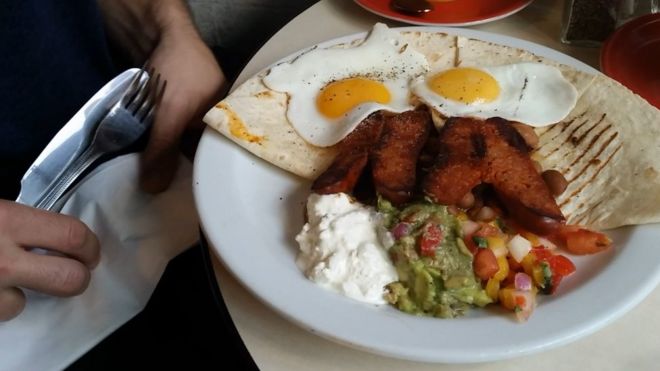
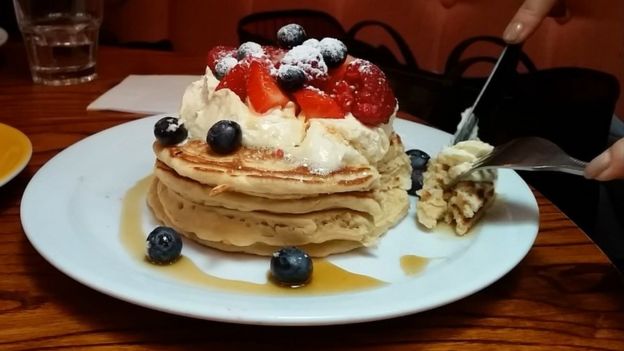
In the past it was all about a sausage and egg fry-up, or a quick croissant on the go. Now, most places will offer an assortment of exotically flavoured granola, bircher muesli or porridge with a twist.

But it's not just that we're harried and "grabbing a bite on the way to work". The first meal of the day has also become a social occasion.

The Breakfast Club is a trendy cafe that started in 2005 and now has nine restaurants across London and Brighton. At the weekend there is often a long queue to get a table.

Indulgence

Founder Jonathan Arana-Morton admits that its success was partly luck - he picked the right market at the right time. He had decided, with his sister-in-law, that they wanted to set up some sort of restaurant and since he was going to be in the kitchen initially, they needed to keep it simple.

Inspired by the great brunches they'd had in New York and Boston, they realised that that part of the day had been neglected in London.

"There's basically three elements to a good brunch - good coffee, good juice and good food," he says. "You used to have to go to three different places for each... and for the food it was usually a greasy spoon."

It's still an indulgence, he says, which is why people are willing to wait. And, he's observed, people increasingly meet for breakfast as a first date - it's much less stressful than in the evening, he suggests, with no expectations of having to go on anywhere afterwards.

Emma Read, from the foodservice consultancy Horizons, also points out that it's a cheaper way of socialising. Her company's research shows that throughout the recession the number of people eating out didn't go down, but that average spending did. She concludes that people have now got into the habit of eating out, and choosing to go out for breakfast is one way of doing that more cheaply.

But the growth in the breakfast market is not just about fashionable cafes, upmarket coffee shops and bakery chains.

Places like Greggs, Wetherspoon pubs and McDonald's, as well as hotels, have really upped their game, says Ms Read.

"Operators have identified what the consumer wants and are offering it to them," she says, whether it's grabbing a porridge on the go or sitting down to eggs benedict.

But perhaps the biggest change in our habits is our thirst for well-made coffee. Lukewarm instant coffee is no longer acceptable - flat whites and soy lattes are a must for any aspiring breakfast establishment.

Coffee connoisseurs

NPD's Cyril Lavenant says: "Coffee is the driver of everything... if you don't serve good coffee, then consumers don't come back. A bartender has to be capable of serving as good a coffee as a pint of beer."

Wetherspoon's won't give any figures on the subject but Matt Gold, manager of one of its pubs in central London, says there's been a steady increase in people coming in for breakfast.

And he certainly sounds as much a coffee connoisseur as a beer buff - explaining how important the "speed of the pour" is in avoiding a bitter taste. He even suggests that a barista's hangover can have an effect - because in that state you tend to bash the equipment about more and press the coffee in too much.

At Wetherspoon's the management conduct regular blind tastings, checking amongst other things whether a straw can stand up straight in the coffee.

But despite all the speciality coffees and smashed avocados on offer, there are some things that haven't changed. Wetherspoon's and researchers NPD both say the same thing.

The nation's favourite breakfast, the one that's ordered more than any other, is the one we're most familiar with: the good old full English of bacon, eggs, beans and toast.

http://www.bbc.co.uk/news/business-37496722
My Name Is KURDISTAN And I Will Be FREE
User avatar
Anthea
Shaswar
Shaswar
Donator
Donator
 
Posts: 31601
Images: 1151
Joined: Thu Oct 18, 2012 2:13 pm
Location: Sitting in front of computer
Highscores: 3
Arcade winning challenges: 6
Has thanked: 6019 times
Been thanked: 746 times
Nationality: Kurd by heart

Re: Food Room

PostAuthor: Anthea » Tue Oct 18, 2016 11:52 pm

The plastic plague: Hormone-disrupting chemicals in everyday things like water bottles DO cause cancer, diabetes, ADHD and autism - and cost US $340 BILLION a year

Endocrine-disrupting chemicals (EDCs) are in thousands of products
Products range from plastic water bottles to cheap toys and cosmetics
Study warns they cause neurological damage and behavioral problems
Exposure to these chemicals cost the US at least $340bn in health a year


Plastic bottles contain hormone-disrupting chemicals that can cause cancer, diabetes, ADHD and autism, scientists confirmed in a report on Tuesday.

Endocrine-disrupting chemicals (EDCs) interfere with the body's hormonal system, affecting development and leaving the body open to a staggering range of diseases.

But they are found in thousands of everyday products, ranging from plastic and metal food containers, to detergents, flame retardants, toys and cosmetics.

These chemicals are responsible for scores of illnesses - costing the US an eye-watering $340 billion in health-related costs each year, the bombshell report by NYU Langone revealed.

The most common EDC-related illness is neurological - including attention-ADHD, autism and loss of IQ.

The invisible but dangerous chemicals also boosted obesity, diabetes, some cancers, male infertility and a painful condition known as endometriosis, the abnormal growth of tissue outside the uterus.

In a country where plastic is rife, these illnesses are not as rare as we may think.

The landmark new study by NYU Langone reveals the economic impact of the chemicals leaves a huge, two per cent dent in the US' gross domestic product (GDP) each year.

'Our research adds to the growing evidence on the tremendous economic as well as human health costs of endocrine-disrupting chemicals,' said lead investigator Leonardo Trasande, an associate professor at NYU Langone in New York City.

'This has the potential to develop into a much larger health and economic issue if no policy action is taken,' he told AFP.

Some of the chemicals highlighted in the report, including phthalates used in bottles, are banned in the European Union - and would therefore not be on sale in Britain.

MailOnline is attempting to find out whether some of the toxins may still be in UK plastic products. But a similar study last year estimated that the chemicals cost the EU health systems $271 billion.

The chemical affect the body's endocrine tissues, which produce essential hormones that help regulate energy levels, reproduction, growth, development, as well as our response to stress and injury.

Mimicking naturally occurring hormones such as estrogen and androgen, EDCs lock on to receptors within a human cell and block the body's own hormones from binding with it.

Recent research has raised red flags showing that 'environmental contaminants can disrupt the endocrine system leading to adverse-health consequences,' according to the US Environmental Protection Agency.

In the US, the biggest chemical culprit by far among the thousands of manmade molecules suspected of interfering with human hormones are so-called PBDEs, found in flame retardants.

Bisphenol A, used to line tin food cans, along with phthalates in plastic food containers and many cosmetics, were also held to be responsible for upward of $50 billion worth of health damages.

A similar study concluded last year that health-related costs of EDCs in the European Union were some $271 billion, about 1.28 percent of GPD.

Crucially, the main drivers of disease and disability were different on either side of the Atlantic, Trasande said.

'US costs are higher mainly because of the widespread use in furniture of brominated flame retardants,' which were banned in the EU in 2008, he explained.

The blood level of these chemicals in the average American would be in the top five percent of Europeans today.

By contrast, the health costs associated with pesticides in food were 10 times higher in the EU than in the United States, where more stringent regulations were put in place to protect pregnant women and children.

To put a figure on the impact of EDCs, the researchers reviewed blood and urine samples from the National Health and Nutrition Examination Survey, which has gathered data since 2009 on major disease risk factors from 5,000 volunteers.

Computer models were then used to project how much each of 15 diseases or conditions was attributable to chemical exposure, and the estimated health costs for each one.

The study was published in The Lancet Diabetes & Endocrinology, a medical journal.

Flame retardants and pesticides in particular are known to affect the developing brain and can lead to loss of IQ.

'Each IQ point lost corresponds to approximately two per cent in lost productivity,' Trasande explained.

The costs and benefits of regulation should be openly debated, the authors argued, citing the decision in the 1970s to ban lead in paint, and then 20 years later in gasoline.

Commenting in the same journal, Michele La Merrill, an expert in environmental toxicology at the University of California in Davis, said the new findings 'provide a lesson on the lasting economic effects of harmful chemicals.'

They should 'inspire a policy shift to end the cat-and-mouse game currently employed the US government and industry.'

The EU set broad criteria in June for identifying potentially harmful EDCs, but consumer and environmental groups said they fell far short of what is needed.

http://www.dailymail.co.uk/health/artic ... hcare.html
My Name Is KURDISTAN And I Will Be FREE
User avatar
Anthea
Shaswar
Shaswar
Donator
Donator
 
Posts: 31601
Images: 1151
Joined: Thu Oct 18, 2012 2:13 pm
Location: Sitting in front of computer
Highscores: 3
Arcade winning challenges: 6
Has thanked: 6019 times
Been thanked: 746 times
Nationality: Kurd by heart

Re: Food Room

PostAuthor: Londoner » Wed Oct 19, 2016 8:06 pm

EDCs!!! they are bad news. I am using cling films to cover my kimchi and checked if they contain EDCs but couldn't find anything. I also use wide top plastic containers to keep my organic honey, mayonnaise and ketchup. Usually the mayonnaise and honey come in tight nick glass containers, which are too difficult to use cling films to separate the food from the air. So when I open them I transfer the food to wide top open plastic containers. It is very easy to cover the top of the food with cling films inside these containers. I think I have to find wide open glass containers to replace these plastic containers. But I have to live with cling films. They have more advantages than their EDCs if they contain any.
User avatar
Londoner
Tuti
Tuti
 
Posts: 1987
Joined: Tue Feb 12, 2008 8:58 am
Highscores: 0
Arcade winning challenges: 0
Has thanked: 0 time
Been thanked: 752 times

Re: Food Room

PostAuthor: Anthea » Wed Oct 19, 2016 11:39 pm

I much prefer storing things in glass jars or bottles

Also, when I occasionally microwave something I use stoneware rather than plastic
My Name Is KURDISTAN And I Will Be FREE
User avatar
Anthea
Shaswar
Shaswar
Donator
Donator
 
Posts: 31601
Images: 1151
Joined: Thu Oct 18, 2012 2:13 pm
Location: Sitting in front of computer
Highscores: 3
Arcade winning challenges: 6
Has thanked: 6019 times
Been thanked: 746 times
Nationality: Kurd by heart

Re: Food Room

PostAuthor: Londoner » Thu Oct 20, 2016 10:06 am

Anthea wrote:I much prefer storing things in glass jars or bottles

Also, when I occasionally microwave something I use stoneware rather than plastic


The problem with bottles and some glass jars is that they speed up oxidation of the food because the food contacting the air. The solution is to use wide open glass jars so that easily one can cover the top of the food with cling films to prevent food oxidation.

I don't use microwave but I thought you can not use plastics in microwave. Because plastics should easily melt in microwaves. Because soft things responds to microwaves by becoming hot. For example a piece of ice can not melt in microwave but liquid water heats up and boils quickly. Microwaves cause molecules of soft things to vibrate and heat up because of friction with each other. But it can not with hard objects.
User avatar
Londoner
Tuti
Tuti
 
Posts: 1987
Joined: Tue Feb 12, 2008 8:58 am
Highscores: 0
Arcade winning challenges: 0
Has thanked: 0 time
Been thanked: 752 times

Re: Food Room

PostAuthor: Anthea » Thu Oct 20, 2016 8:51 pm

Londoner wrote:I don't use microwave but I thought you can not use plastics in microwave. Because plastics should easily melt in microwaves. Because soft things responds to microwaves by becoming hot. For example a piece of ice can not melt in microwave but liquid water heats up and boils quickly. Microwaves cause molecules of soft things to vibrate and heat up because of friction with each other. But it can not with hard objects.

Some plastics are supposed to be microwave safe but I never like to use them

I did not know that ice does not melt in microwaves :shock:
My Name Is KURDISTAN And I Will Be FREE
User avatar
Anthea
Shaswar
Shaswar
Donator
Donator
 
Posts: 31601
Images: 1151
Joined: Thu Oct 18, 2012 2:13 pm
Location: Sitting in front of computer
Highscores: 3
Arcade winning challenges: 6
Has thanked: 6019 times
Been thanked: 746 times
Nationality: Kurd by heart

PreviousNext

Return to Food

Who is online

Registered users: Bing [Bot], Google [Bot]

x

#{title}

#{text}